
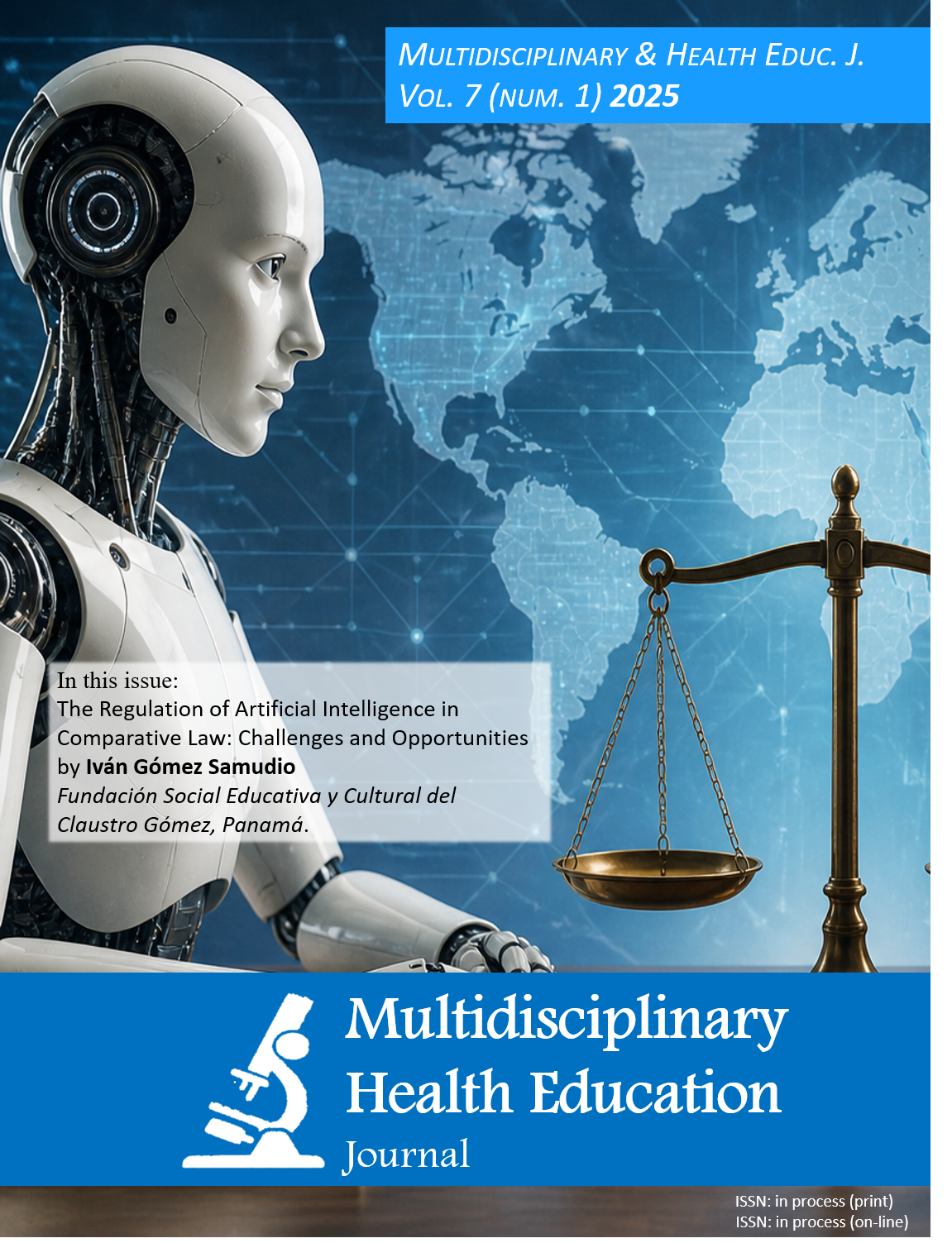
The Regulation of Artificial Intelligence in Comparative Law: Challenges and Opportunities
Keywords:
Artificial Intelligence (AI), Regulation, Jurisdictions, Challenges, HarmonizationAbstract
The present article addresses the growing importance of regulating Artificial Intelligence (AI) in a global context characterized by interconnectivity and technological advancement. It examines how various jurisdictions are tackling the legal challenges associated with AI, highlighting both their differences and similarities. Beyond a mere comparison of laws, this study delves into the complexity of issues arising at the intersection of technology and law. Employing a qualitative and subjective approach, it identifies the primary challenges and opportunities facing AI regulation, with the ultimate goal of seeking pathways toward international legal harmonization. Current barriers are underscored, and promising perspectives for the ethical and responsible development of AI in contemporary society are explored.
References
Granero, H. R. (2021). Inteligencia artificial y derecho, un reto social. elDial.com.
Herbosa Martínez, I., & Fernández de Retana Gorostizagoiza, D. (2023). Derecho e Inteligencia Artificial: El jurista ante los retos de la era digital. Aranzadi / Civitas.
Holmes, W., Zhang, H., Fengchun, M., Huang, R., & UNESCO. (2021). Inteligencia artificial y educación: Guía para las personas a cargo de formular políticas. UNESCO Publishing.
Serrano Antón, F. (2021). Inteligencia artificial y administración tributaria: eficiencia administrativa y defensa de los derechos de los contribuyentes. Aranzadi / Civitas.
Brossi, L., Dodds, T., & Passeron, E. (2019). Inteligencia artificial y bienestar de las juventudes en América Latina. LOM Ediciones.
Downloads
Additional Files
Published
How to Cite
Issue
Section
License
Copyright (c) 2026 Multidisciplinary & Health Education Journal

This work is licensed under a Creative Commons Attribution-NonCommercial-NoDerivatives 4.0 International License.