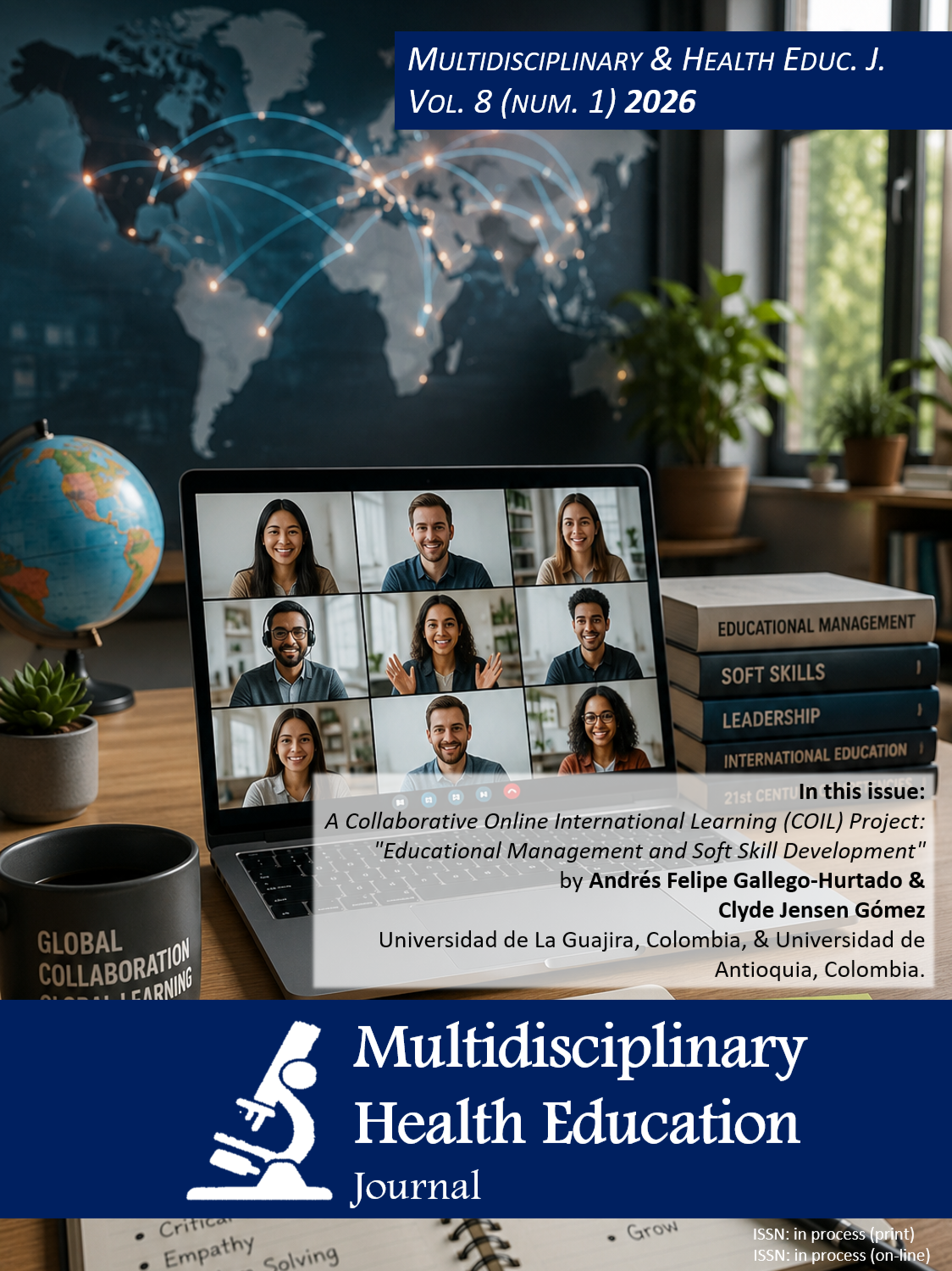
A Collaborative Online International Learning (COIL) Project: "Educational Management and Soft Skill Development"
Keywords:
Collaborative learning, Pedagogical skills, Online learning, Educational management, MethodologiesAbstract
Within the context of globalization and the Fourth Industrial Revolution, internationalization strategies in Higher Education Institutions (HEIs) have become one of the most outstanding aspects in the field of education, as a response to the dynamics generated by the process of globalization. During 2024, a University from Peru and a University from Colombia designed, implemented, and evaluated the implementation of a project using the COIL methodology, based on knowledge exchange, experiences, soft skill development and competencies mediated by ICTs. The general objective was to develop competencies and skills in professionals in educational management in a COIL (Collaborative Online International Learning) context. The idea was to promote continuous improvement in educational processes and foster collaboration and internationalization in the management of educational institutions. The study focuses on the collaborative construction of knowledge about skills, knowledge, and competencies in the practical course: "Practicum in Educational Management." Methodologically, the sample consisted of 41 students enrolled in the professional practicum. Due to the nature of the project, a qualitative research paradigm was applied to describe and explain the social phenomenon, using two data collection instruments: 1) documentary analysis, and 2) survey. During the project implementation, a strengthening of soft skills such as critical and reflective thinking, teamwork, creativity, empathy, and problem-solving, through participation in collaborative activities and intercultural exchanges was found among the participants. This fostered an environment of respect, appreciation of diversity, and the construction of harmonious and productive relationships in a globalized setting within a virtual learning environment. A finding of the COIL project was an effective strategy in shifting from traditional practices to the creation of innovative learning environments in Higher Education Institutions. This enhances the development of 21st Century skills and competencies in future education professionals.
References
Adell, J. y Castañeda, L. (2015). Las pedagogías escolares emergentes. Cuadernos de Pedagogía, (462), 21-25. https://digitum.um.es/digitum/bitstream/10201/49329/1/2015cuader..a.pdf
Barroso-Tanoira, F. G. y Ruiz-Lozano, D. (2022). La metodología COIL como alternativa global para el desarrollo de competencias interculturales y digitales. En M. E. Prieto, S. J. Pech y S. del C. Herrera (Eds.), Avances tecnológicos en la educación y el aprendizaje (pp. 54-65). CIATA.org-UNACAR. https://ruidera.uclm.es/server/api/core/bitstreams/a0c1278d-f06b-488b-aa57-b6edec57b4d3/content
Daza Álvarez, C. R., Rojas Martínez, P. A. y Cuellar Campo, D. A. (2012). Apropiación del horizonte institucional de la Institución Educativa Andino San Lorenzo, Bolívar Cauca [Tesis de especialización, Universidad Católica de Manizales]. Repositorio UCM. https://repositorio.ucm.edu.co/entities/publication/b6e26df6-6199-478f-82b6-72e9d4c4a21e
Glinz Férez, P. E. (2005). Un acercamiento al trabajo colaborativo. Revista Iberoamericana de Educación, 36(7), 1-14. https://doi.org/10.35362/rie3672927
Gaytán-Oyarzun, J. C., Cravioto-Torres, R., Mendoza-Meza, E. y Ortiz-Zarco, E. (2022). La implementación de la metodología COIL, como estrategia para potenciar el proceso de enseñanza aprendizaje y la movilidad académica y estudiantil en la modalidad virtual. Revista de Innovación y Buenas Prácticas Docentes, 11(1), 141-149. https://helvia.uco.es/xmlui/handle/10396/25485
Hernández Sampieri, R., Fernández Collado, C. y Baptista Lucio, P. (2014). Metodología de la investigación (6.ª ed.). McGraw-Hill Interamericana. https://www.uca.ac.cr/wp-content/uploads/2017/10/Investigacion.pdf
López Calva, J. M. (2006). Pensamiento crítico y creatividad en el aula (2.ª ed., reimp.). Trillas. (Obra original publicada en 1998)
Meza Morón, O. P. (2018). Proyecto de docencia colaborativa basada en el modelo COIL. Universidad La Salle. https://repositorio.lasalle.mx/handle/lasalle/760
Velázquez Moreno, D. A. (2020). Estrategia de aprendizaje innovadora para la internacionalización en casa: metodología COIL. Revista Científica Estudios e Investigaciones, 9, 85-86. http://revista.unibe.edu.py/index.php/rcei/article/view/526
Domínguez Cuña, A., Muñoz Carril, P. C. y Rodríguez Machado, E. (2003). Metodología cuantitativa: métodos y técnicas de evaluación de centros, una propuesta de clasificación operativo-funcional. Revista Galego-Portuguesa de Psicoloxía e Educación, 9, 69-96. https://ruc.udc.es/dspace/handle/2183/6936
Oppenheimer, A. (2018). ¡Sálvese quien pueda! El futuro del trabajo en la era de la automatización. Debate.
Prendes Espinosa, M. P. y Cerdán Cartagena, F. (2021). Tecnologías avanzadas para afrontar el reto de la innovación educativa. RIED. Revista Iberoamericana de Educación a Distancia, 24(1), 35-53. https://doi.org/10.5944/ried.24.1.28415
Hernández-Sampieri, R. y Mendoza Torres, C. P. (2018). Metodología de la investigación: las rutas cuantitativa, cualitativa y mixta. McGraw-Hill Education.
Hernández Sampieri, R., Fernández Collado, C. y Baptista Lucio, P. (2014). Definiciones de los enfoques cuantitativo y cualitativo, sus similitudes y diferencias. En Metodología de la investigación (6.ª ed., pp. 2-21). McGraw-Hill Interamericana.
Zabalza Beraza, M. Á. (2003). Competencias docentes del profesorado universitario: calidad y desarrollo profesional. Narcea Ediciones.
Downloads
Additional Files
Published
How to Cite
Issue
Section
License
Copyright (c) 2026 Multidisciplinary & Health Education Journal

This work is licensed under a Creative Commons Attribution-NonCommercial-NoDerivatives 4.0 International License.